1. Home
  2. Work
  3. The agent office and Graf Edzard

An office of agents, one person in charge

I run several products alone. Work has to keep moving without me checking every change or answering every question. So the departments are AI agents on one ticket board, and only real decisions reach me.

Business
All my own work
My role
Designed it, set the goals
Since
May 2026
Status
New flow, in trial since November 2026
7

agent roles

What it is: the seven AI personas I work with: CEO, UX, sales, marketing, legal and money, QA and the outside check.

Why it matters

each one has a short written file that says what it owns and what it must never do.

Meet the personas
5

project lanes on one board

What it is: my five areas of work, all on one ticket board.

Why it matters

every agent reads, claims and hands back work in the same place, so nothing gets lost between projects.

The system underneath
835

commits since May 2026

What it is: saved changes to the office's own code since I started it.

Why it matters

this is the system I actively work in, and it keeps changing as I go.

1.400

automated tests, about

What it is: small programs that check the office's own code after every change.

Why it matters

the merge check refuses a change without a QA pass.

Step 06, Trinity QA

Counted from the office's own repository and agent files, read 2026-11-16. 11 timed jobs run on the office server. The department flow is new and in trial until 23 November 2026, so I show how it works, not results.

The story behind it

My whole work environment

  1. My work happens in the terminal. I use Claude Code and Codex every day. This office is how I work right now, my operating system for every project I run.

  2. I run several products alone. Work has to keep moving without me checking every change or answering every question.

  3. The departments are AI agents, each with a name and a short role file: what it owns and what it must never do. Graf Edzard is the CEO. Link does UX, Alex sales, Zoe marketing, James legal and money, Trinity QA. Rewind is the outside check. I work with these personas every day.
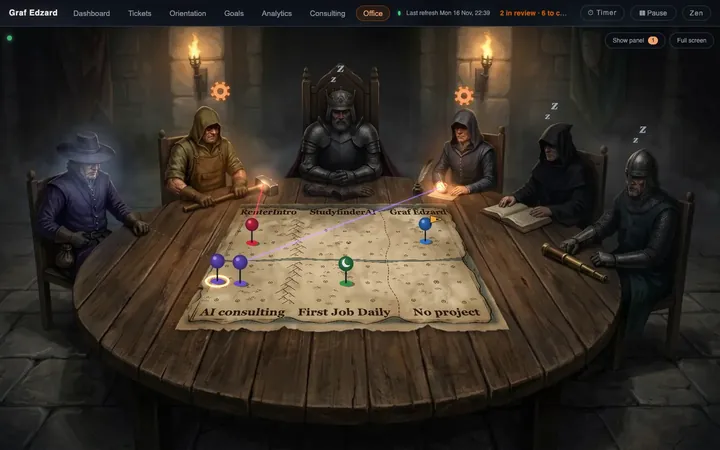
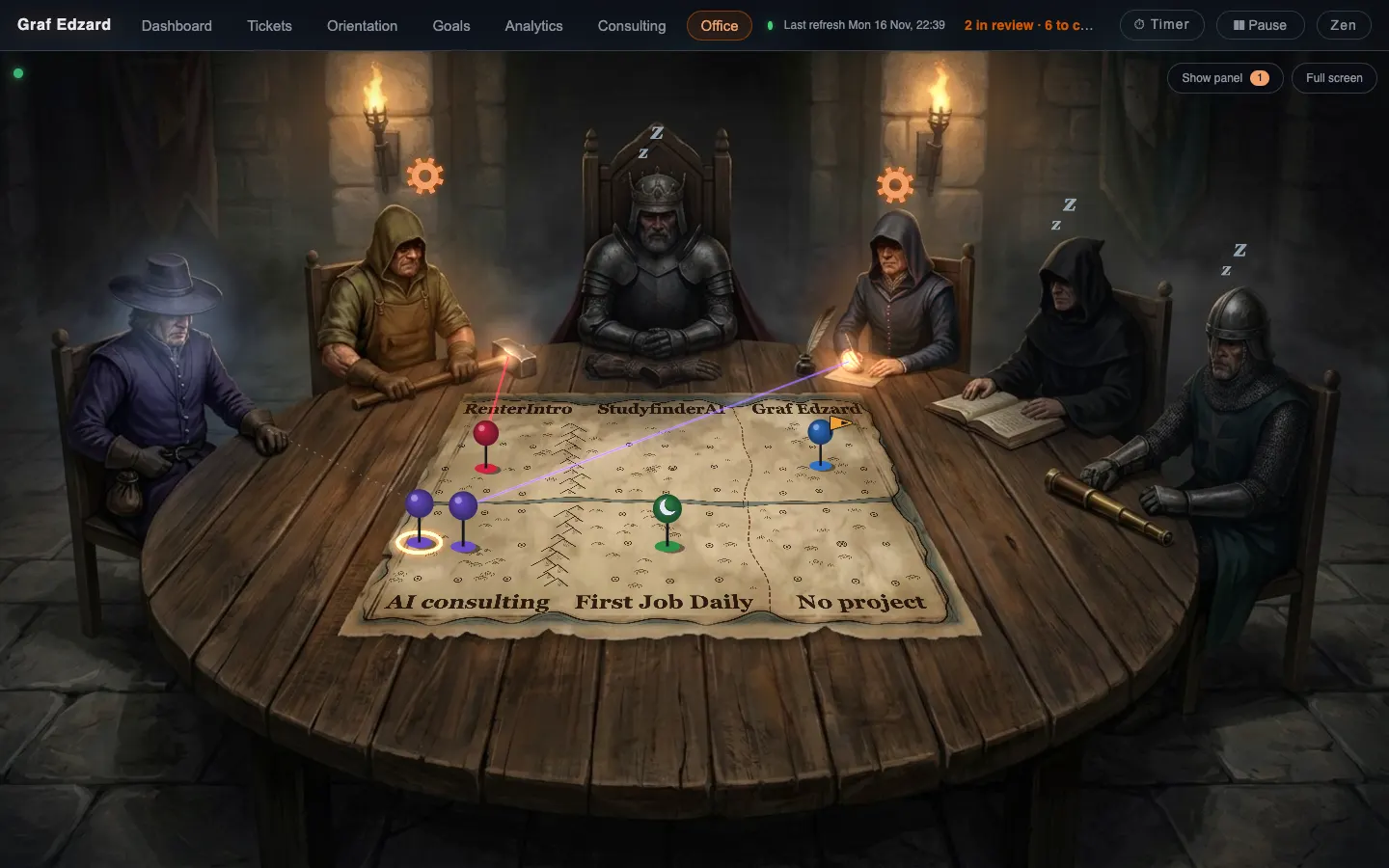
    The live hall of my dashboard: six AI personas around a table, with a map of my projects in front of them. From left: Alex with a hat, Link with a hammer, Graf Edzard in the centre, Zoe with a quill, James with a book and Trinity with a spyglass. (opens large)
    The live hall in my dashboard, with sample tickets. From left: Alex, Link, Graf Edzard, Zoe, James, Trinity.

    • Alex

      Sales

      Makes the offer worth more to the buyer.

      Never makes it look worth more than it is.

    • Link

      UX and design

      Builds and checks everything a person sees or clicks, on phone and desktop.

      Never fills a page with made-up content, numbers or quotes.

    • Graf Edzard

      CEO

      Settles disagreements between departments and decides what it can, so only real decisions reach me.

      Never reviews every change or redoes a department's work.

    • Zoe

      Marketing and copy

      Writes what people outside read, in my voice and by my written rules.

      Never invents a claim or a number the docs don't hold.

    • James

      Legal and money

      Keeps us legal and uses the full range the law allows.

      Never calls a refund a guarantee unless it gives more than the legal minimum.

    • Trinity

      QA

      Tests the result from the customer's side, for real, with real data.

      Never writes or fixes code. She only reports.

    • Rewind

      The outside check, not at the table

      Looks at finished work like a colleague who wasn't in the room, and lists at most 3 things that were missed.

      Never edits anything.

  4. Every piece of work starts as a ticket with one line that says when it's done. In the morning I pick the tickets for the day, and each one gets its own session in its own copy of the code. The department does its part. Rewind, who wasn't in the room, lists what it missed. Trinity runs the check for real, with real data. Only then does the ticket close, with the evidence attached.
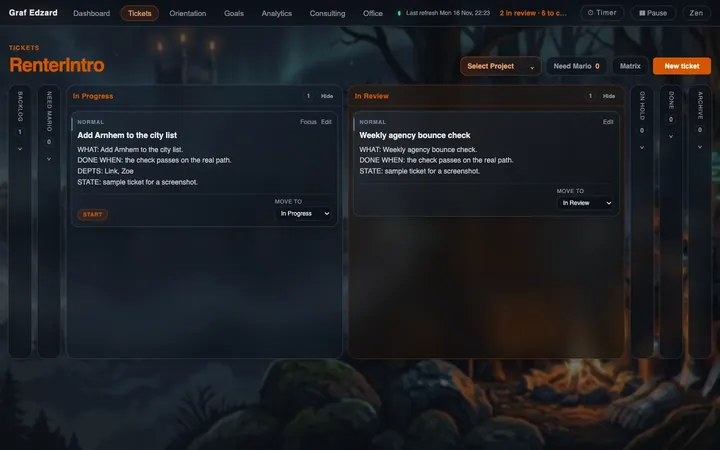
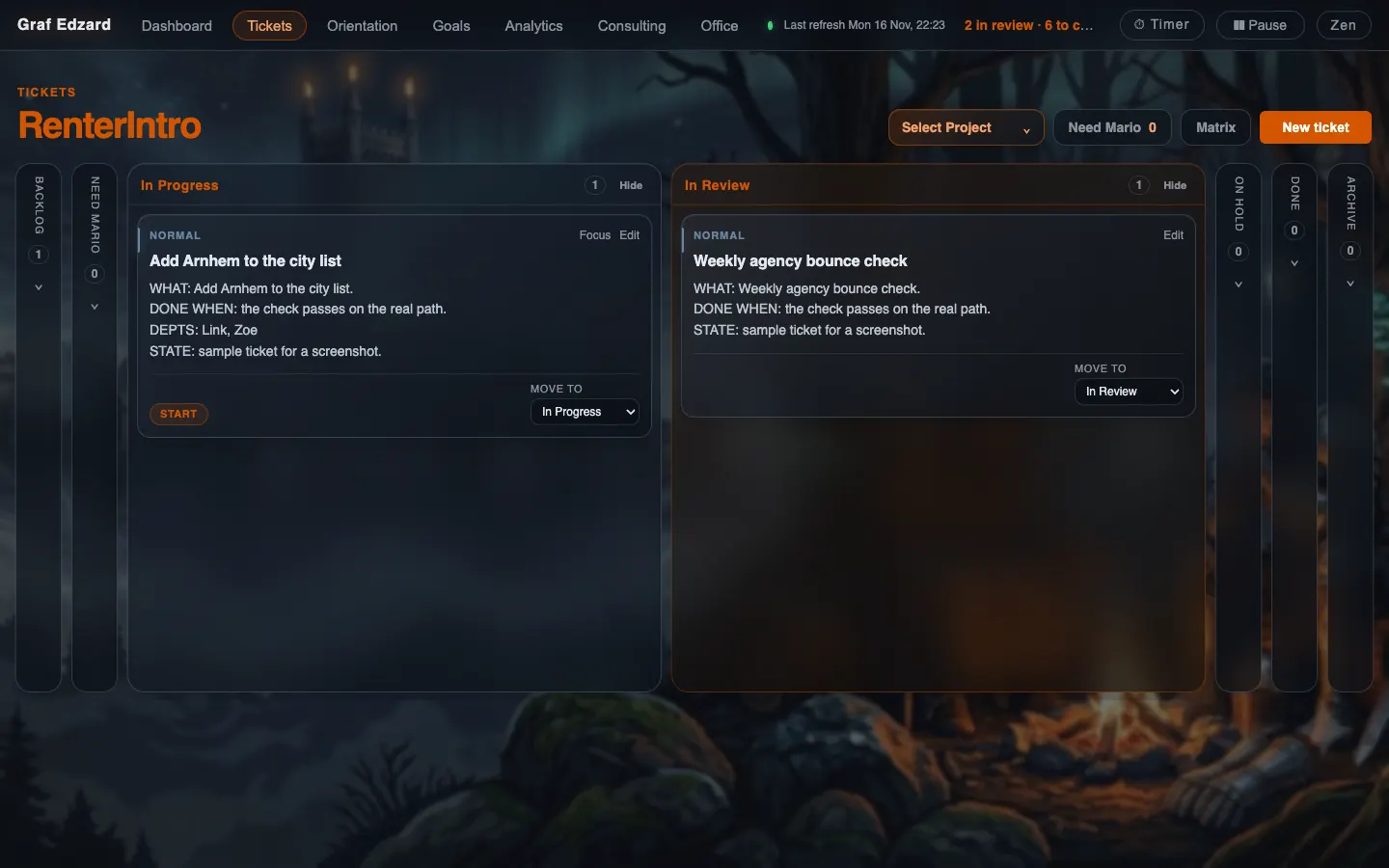
    The ticket board in my dashboard for one lane, RenterIntro: one sample ticket in progress and one in review, each with a what line and a done when line. (opens large)
    My ticket board, one lane, with sample tickets.
  5. The one who builds is never the one who checks. A green build isn't proof. And only real decisions reach me.

    Graf Edzard settles the rest and brings me options with a recommendation.

  6. I run my day from a dashboard: tickets, this week, what needs me, goals and numbers per business. A live office view shows every agent session as it works, in the office tab and on the live screen. Who is busy, who waits for me, what sits in review.
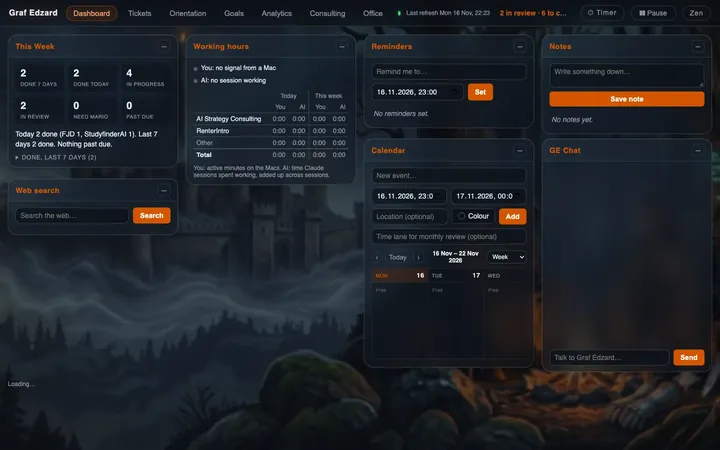
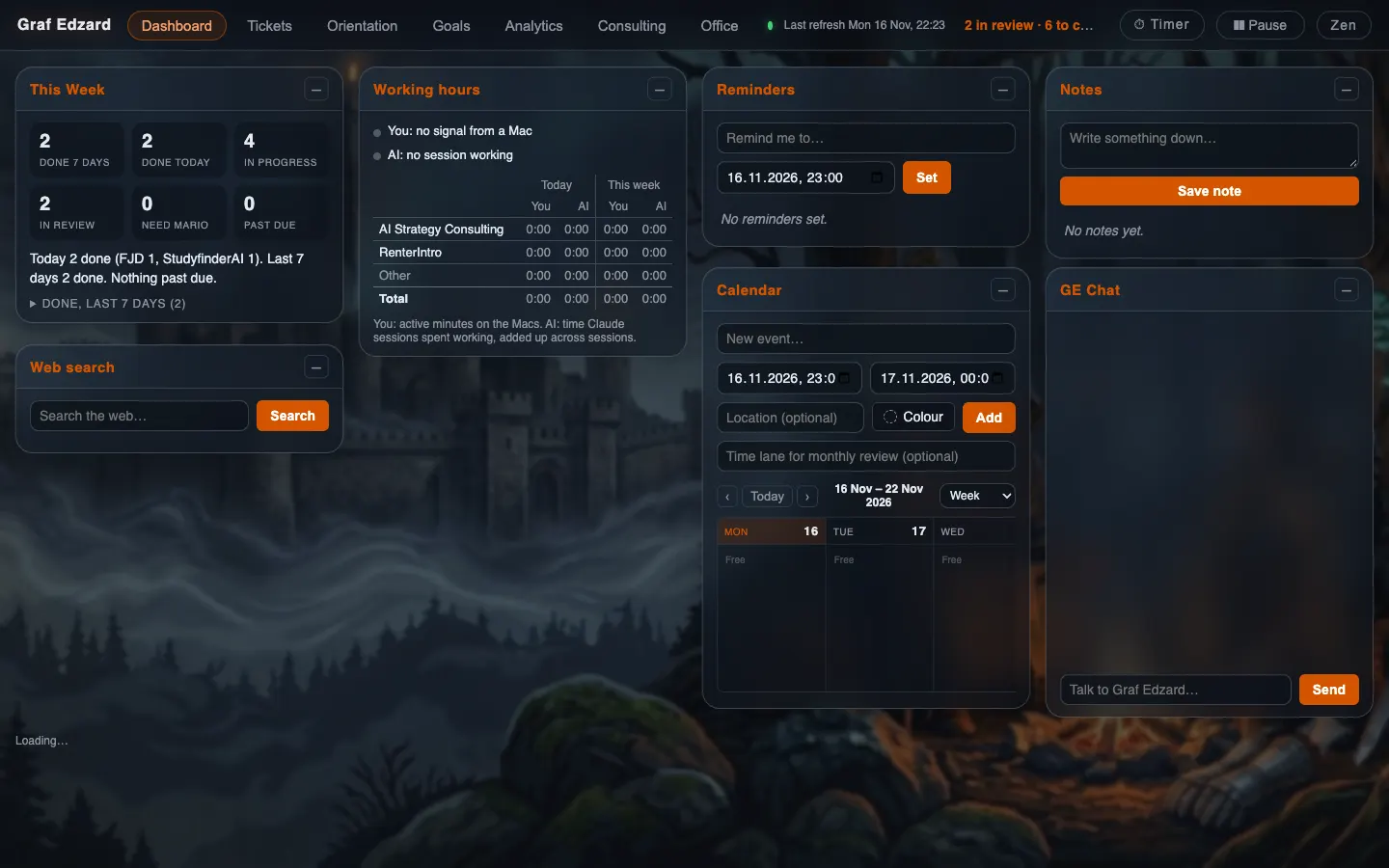
    The dashboard tab: this week's counts, working hours per lane, reminders, a calendar, notes and a chat with Graf Edzard. (opens large)
    My dashboard, with sample tickets.
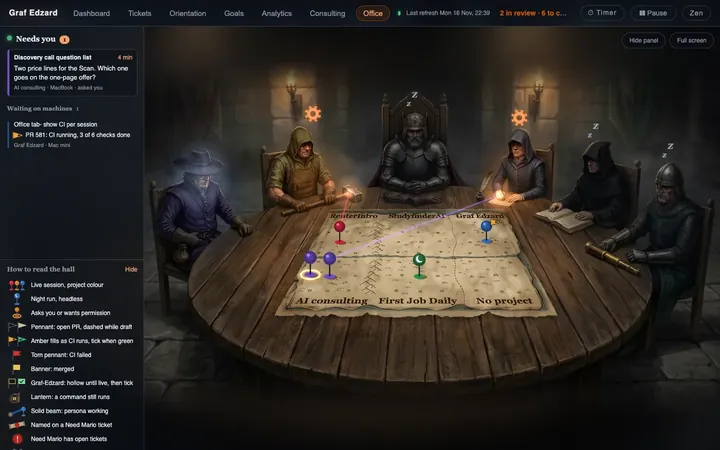
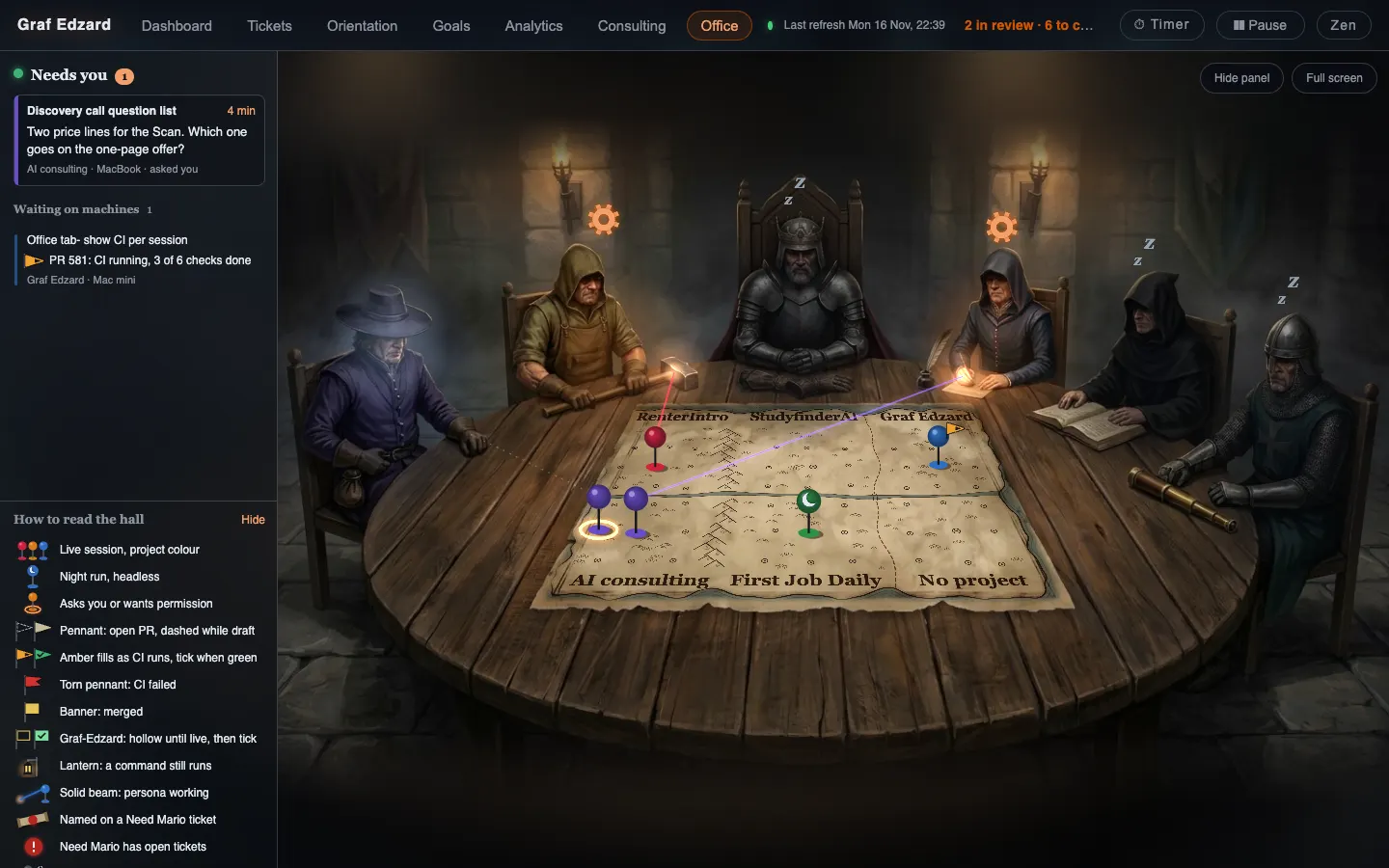
    The office tab: the live hall with the Needs you panel on the left, which says nothing needs me, and a legend for reading the hall. (opens large)
    The office tab, with the Needs you panel.

    The screen saver: an illustrated castle at night and two figures at a campfire, with a small control bar at the bottom. (opens large)
    The screen saver.

How it runs

Eight steps, from idea to done

Scroll through the steps. The shape of each marker shows who is in charge; each step links to its detail below.

  • AI
  • Fixed rules
  • A person decides
  1. 01Fixed rules

    Ticket

    All work becomes a ticket on one board. Every ticket has a "done when" line: a check anyone can run, and the result that proves it.

    Step 01 in detail
  2. 02A person decides

    Morning pick

    Each morning I pick the projects and the tickets for the day. Every pick gets its own agent session, in its own copy of the code.

    Step 02 in detail
  3. 03AI

    Departments

    Department agents do the work in their field: UX and design, sales, marketing and copy, legal and money.

    Step 03 in detail
  4. 04Fixed rules

    Risk level

    Green: the agent ships the change on its own. Amber: it ships and writes down why. Red: the agent stops and waits for me.

    Step 04 in detail
  5. 05AI

    Rewind

    After a department finishes, an outside agent with no shared history looks at the work and lists at most 3 things that were missed.

    Step 05 in detail
  6. 06AI, with rules enforcing it

    Trinity QA

    The QA agent runs the "done when" check for real, with real data.

    Step 06 in detail
  7. 07Fixed rules

    Done with evidence

    A ticket closes only with evidence for five things: acceptance, tests, the state after merge, the deploy, and what's still open.

    Step 07 in detail
  8. 08A person decides

    Decisions to me

    A CEO agent sits between the departments and me. It settles disagreements and filters questions.

    Step 08 in detail

One ticket

The path every piece of work takes

A ticket moves left to right. It only reaches Done when the evidence is in.

Ticket

The work, with a check anyone can run to prove it's done.

Department

UX, sales, marketing or legal does its part.

Rewind

An outside agent lists what was missed.

Trinity QA

Runs the check for real, with real data.

Done

Closed only with evidence attached.

The system underneath

Graf Edzard, my personal AI system

The agents are the office. Graf Edzard is what they run on: one board for all my work, a schedule that keeps going while I sleep, and a private memory.

  • One board for every business. All work in my 5 project lanes is a ticket there: about 970 since May 2026. Agents read it, claim from it and hand back to it.
  • A dashboard I run my day from. Tickets, this week, what needs me, goals, analytics per business, and finances behind a password.
  • A live office view. Every agent session on my Macs shows up as it works: who is busy, who waits for me, which change sits in review.
  • A schedule that runs without me. 11 timed jobs on a small server, from a mail watch every 2 minutes to a morning ticket sweep and a weekly learning loop, plus fixed runs on a Mac mini.
  • A private memory. The brain vault: about 1.500 notes on goals, decisions, wins and learnings. The server is the only one allowed to write to it.
  • Nothing lives in one place. The system state is backed up off-site every night.

Step by step

What happens at each step

01Ticket

Fixed rules

All work becomes a ticket on one board. Every ticket has a "done when" line: a check anyone can run, and the result that proves it.

02Morning pick

A person decides

Each morning I pick the projects and the tickets for the day. Every pick gets its own agent session, in its own copy of the code.

03Departments

AI

Department agents do the work in their field: UX and design, sales, marketing and copy, legal and money. Each one has a short written role file that says what it owns and what it must never do.

04Risk level

Fixed rules

  • Green: the agent ships the change on its own.
  • Amber: it ships and writes down why.
  • Red: the agent stops and waits for me. Red covers deleting or exporting personal data, messages to real people outside the normal path, credentials, new dependencies and anything that rewrites history.
  • An agent only decides on its own when it's more than 80% sure. Otherwise it asks in a fixed format: question, options, cost of waiting, evidence.
05Rewind

AI

After a department finishes, an outside agent with no shared history looks at the work and lists at most 3 things that were missed. It never edits. The department fixes them.

06Trinity QA

AI, with rules enforcing it

  • The QA agent runs the "done when" check for real, with real data. A green build alone isn't proof.
  • It tests by risk, in this order: money, personal data, mail to real people, promises, then layout.
  • The merge check refuses a change without a QA pass.
07Done with evidence

Fixed rules

A ticket closes only with evidence for five things: acceptance, tests, the state after merge, the deploy, and what's still open. A merged change moves its ticket to review by itself. A ticket idle for 3 days is reopened, never closed quietly.

08Decisions to me

A person decides

A CEO agent sits between the departments and me. It settles disagreements and filters questions. Only real decisions reach me, each with options and a recommendation.

Guardrails

What keeps it safe

  • Red always waits. Deleting or exporting personal data, messages outside the normal path and credentials need a person.
  • Builder and checker are separate. Different agents, no shared history.
  • No silent closing. Idle work is reopened, never closed without evidence.
  • The model only suggests. A weekly learning loop reads stored numbers and suggests at most 3 changes. Each one becomes a yes or no ticket for me.
  • Role files stay short. Each agent's instructions have a hard length limit, checked automatically.

Built with

Stack, in plain words

  • AI coding agents, Claude Code and Codex.
  • A Python ticket board and dashboard on a small server.
  • 11 timed jobs on that server, from a mail watch every 2 minutes to a weekly learning loop.
  • GitHub pull requests and automated checks on every change.
  • A live view of every running session, and a nightly off-site backup.

What went wrong

What broke, and what I changed

  • Runs that did nothing reported success. On 9 November 2026 four outreach runs had no browser tools, did nothing, and still finished as fine, so no alert went out. Now a run like that counts as failed, and I get a ticket after 2 failures.
  • Tickets went stale. Work sat idle in review or in progress. Now a daily sweep sends anything untouched for 3 days back to open, with a dated note.

For your business

What you can take from it

  1. Write the decision rules down.

    Risk levels and a clear confidence line let AI act without asking you every time, and stop where it should.

  2. Never accept done without evidence.

    A green build isn't proof. Ask for the check that shows it works on the real path.

  3. Separate the builder from the checker.

    The one who did the work should not be the one who approves it. That holds for agents and for people.

Sources: the office's work contract, state file, agent role files, ticket board, brain vault and git history, read 2026-11-16.

Contact

Tell me what is stuck

Book 30 minutes on video, or write me a few lines about which AI tools your team uses and where it gets stuck.

Book a 30-minute call

consulting@mario-behrends.com
LinkedInEnglish and German.